
Supplying quality point-of-lay Brown Shaver pullets to commercial egg producers, and household customers throughout Canterbury and Otago.
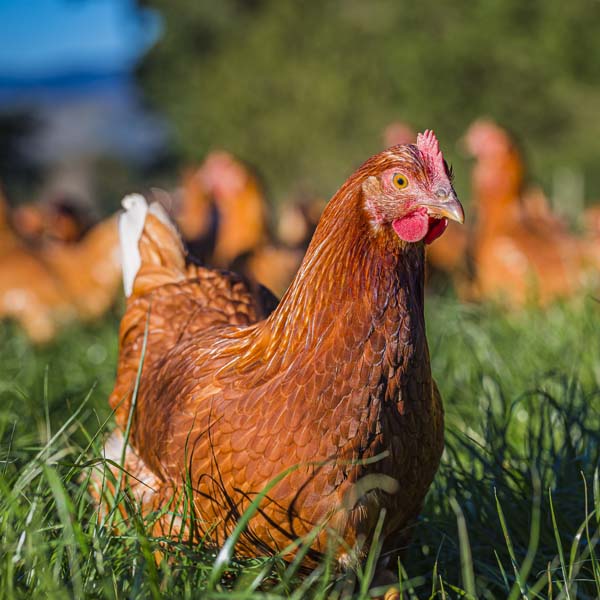
We pride ourselves on raising happy, healthy laying hens which are allowed to roam freely in our pastures on the farm as soon as they are fully feathered.
Our breed of choice is the Brown Shaver – a high performing hen which has been bred specifically to produce quality brown eggs. Shavers are one of the two main commercial laying breeds in New Zealand. Unlike some heritage breeds, they will continue to lay throughout the winter, and produce an average of 300 eggs in their first year!
We work very hard to make sure we rear each batch of chicks in small flocks as to ensure optimum growth rates and minimise any pecking order problems. Liveweight gain is key to laying performance, so we focus on growing our pullets as well as possible to ensure optimum egg production after they go to their new homes.
All pullets are fully vaccinated against salmonella and meet all the requirements for supply to commercial egg farms.
We’re Natalie and Adam – a husband and wife team passionate about producing healthy, high-quality laying hens. From an early age, our pullets are encouraged to free-range, allowing them to express natural behaviours while growing into confident, well-adjusted birds.
Our pullets aren’t confined to fixed runs. Instead, they have access to fresh water and mixed-sward pastures year-round. Their relocatable sheds are positioned near established trees, providing shade, shelter and a sense of security. It’s always a highlight watching the young chickens explore the treelines, dustbathe beneath the trees and perch on low branches as they grow.
Our business is very much a family effort. Alongside running our sheep and beef farm, we’re also raising our three young children. While they’re still little, they’re already growing up surrounded by chickens and farm life, and we love seeing their excitement when they’re out checking on the birds, collecting the odd egg or coming along on delivery days.
We love seeing other families share that same experience. There’s something special about children collecting their first eggs, choosing their favourite hen, or meeting their new pullets at one of our collection points. We hope our birds bring as much enjoyment to your family as they do to ours.
The name “The Chicken Lady” dates back to when we first started delivering pullets directly to customers’ homes. Natalie would often knock on the door and hear someone call out, “It’s the Chicken Lady!” The name stuck, and we’ve proudly embraced it ever since. While biosecurity and the growth of our business mean we now operate from central collection points rather than delivering to individual properties, we still enjoy meeting customers and their families as we travel throughout Canterbury and Otago.
While running a sheep and beef operation with family, we are spreading our wings in the business of chicken rearing…
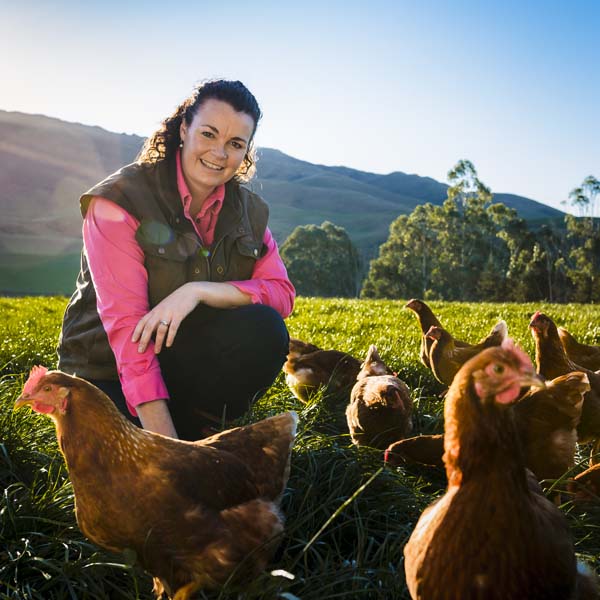
Our household customers receive 18-week-old point-of-lay pullets. At this age, they are fully feathered, well grown, and close to the start of their laying career. Depending on the time of year and daylight hours, most will begin laying between 18 and 22 weeks of age.
Our commercial customers generally take their pullets at 16 weeks of age. This allows time for the birds to settle into their new environment before the onset of lay, helping minimise stress and maximise production.
We also offer limited numbers of day-old Brown Shaver chicks throughout the year to help address the shortage of quality laying birds. These chicks are:
Guaranteed female (sexed).
Vaccinated against Marek’s disease at hatch.
Given their first Salmonella Enteritidis vaccination.
We’re always happy to provide advice and support if you’d like to rear your own laying hens from day-old chicks.
No. Biosecurity is extremely important to us and to the commercial poultry industry. To help protect the health of our birds and those of our commercial customers, we do not allow farm pick-ups or visitor access to our rearing facilities.
Instead, we operate regular delivery routes to convenient central collection points throughout the South Island.
We have batches of 18-week-old Brown Shaver pullets available approximately every six weeks, year-round.
Collection points are available throughout South Canterbury, North Otago, Otago and Central Otago, with additional special delivery routes offered throughout the year.
Delivery charges apply to help cover travel costs.
Collection points and dates vary depending on the delivery route. Full details can be found on our Collection Points page, and we’ll email you closer to delivery day to remind you of your collection time and meeting location.
Day-old chicks are currently available for collection from our central collection points in Waimate, Timaru and Oamaru only.
Yes please!
As we transport our pullets in poultry crates, we ask our customers to bring a box/crate/cage when they meet us on collection day. Please ensure your box has good ventilation and is a suitable size for the number of pullets you have purchased.
As a guide, a banana box will hold 5-6 pullets, and a cat cage 2-3.
Sacks, plastic tubs and buckets with lids are not a suitable way to take your new hens home, and we’d rather refund you on the spot than send our ladies home in these.
Our day-old chicks have been vaccinated for salmonella and Mareks disease before they come to us. We do another two salmonella vaccinations for our point of lay pullets before they leave us for their new homes.
No, we will choose them for you, but don’t worry… all of our hens are amazing!
They sure are. We pride ourselves on producing happy, healthy laying hens which are allowed to roam freely in our pastures on the farm as soon as they are fully feathered and no longer require a heat source.
I’m pretty sure chickens are part labrador when it comes to food, but no they won’t be used to a treadle/step-on feeder as we use much larger feeders where the chickens have easy, all-day access to feed.
In the first few days after they get home, consider leaving the feeder partially open until they learn to step up and use it (a clothes peg works well to hold the lid up on some versions), and minimise any noise the feeder makes when shutting so they don’t become scared by it.
Ensure manure/soil does not build up under the step over time and observe to ensure all hens are using it and feed level is dropping – poorly fed hens will be poor performers.
Brown Shavers are one of the world’s leading commercial laying breeds and are renowned for their excellent egg production.
Under good management, you can expect around 300+ eggs during their first laying year. For most backyard flocks, a realistic expectation is around six eggs per hen per week on average over the course of the year.
Keep in mind that egg production naturally varies throughout the year. Young pullets take a few weeks to reach full production, while shorter daylight hours during winter may temporarily reduce laying. Nutrition, access to fresh water, health, stress and housing also play an important role in how well your hens perform.
Production gradually declines as hens age. Most commercial flocks are replaced between 18 and 24 months of age to maintain peak egg production and egg quality. Backyard hens often continue laying well beyond this, although at a lower rate.
Providing a quality layer feed, clean water, suitable housing and good general care will help your hens reach their full laying potential.
In most cases, no.
As our business has grown, we’ve moved from individual property deliveries and custom meeting locations to a network of central collection points. This allows us to deliver to more customers across the South Island while keeping our delivery routes running smoothly.
We’ve carefully selected our collection points to provide plenty of space for parking and loading birds, minimise disruption to the public, and create a safe environment where families can bring children along to collect their new chickens.
Our collection schedule is carefully planned, with customers meeting us at set times throughout the day. Even a short unscheduled stop of just a few minutes can quickly snowball, leaving customers further along the route waiting and putting us behind schedule for the rest of the day.
For this reason, we’re generally unable to make additional stops between collection points.
We’ll email you before your collection day with your collection time, meeting location and everything you need to know for a smooth pick-up.
If you’re placing a large commercial order or have exceptional circumstances, please get in touch. While we can’t make any promises, we’re always happy to discuss whether an alternative arrangement may be possible.
Yes. We supply commercial quantities of Brown Shaver point-of-lay pullets to a number of free-range egg producers throughout the South Island.
While we are still a relatively small operation, we’re always keen to work with new and growing egg producers. If you’re planning to establish or expand a free-range flock, we’d love to discuss your requirements and future availability.
Please get in touch to discuss bird numbers, timing and upcoming batches.
Probably not! The vast majority of our pullets are already confidently perching by the time they arrive at their new home – that’s one of our points of difference.
From a young age, we manually place our chicks onto their perches every evening (yes, every single one of them… sometimes more than once!) until they learn to perch on their own. It’s a labour-intensive process, but we believe it’s well worth it.
Perch-trained pullets settle into their new homes more quickly, are less likely to sleep on the floor, and generally enjoy better welfare. It also saves you the time and hassle of teaching them yourself.
We raise Brown Shavers – a commercial breed of laying hen, known for prolific egg production and their friendly, inquisitive natures.
No, we don’t have any egg production at our place, so all chickens are sold as either day-olds, or point-of-lay pullets. For end-of-lay hens, you might be best to try a local free range egg farm.
Point-of-lay pullets are defined as hens which are just about to begin laying for the first time. While there are a number of factors which help determine the start of lay, daylength is a contributing factor.
As a guide, Brown Shaver pullets will begin laying between 18-22 weeks of age, with the latter usually being in the middle of winter when days are shortest.
If your hens aren’t laying on arrival, give them a week or two to settle in – it’s a big adjustment to go to a new home, often with different feed, noises and views!
We don’t sell eggs, we just focus on rearing the best pullets we possibly can.
We understand that our pullets aren’t the cheapest on the market – and that’s intentional.
Every bird we sell has been reared from a day-old chick with a focus on health, welfare and long-term performance. We don’t cut corners.
Our pullets are:
Fully vaccinated.
Commercially reared using quality feed and carefully managed lighting programmes.
Regularly weighed to ensure consistent growth and development.
Hand-trained to perch, helping them settle quickly into their new home.
Free-range reared from a young age, allowing them to develop naturally.
Sold at point-of-lay, ready to begin their first laying season.
We also provide ongoing support before and after your purchase. Whether you have questions about feeding, housing, health or egg production, we’re only an email or phone call away.
A cheap hen can quickly become an expensive decision in the long run. Birds that haven’t been well reared or properly managed may take longer to start laying, produce fewer eggs, experience more health issues, or simply not perform as expected.
Our aim isn’t to sell the cheapest chickens – it’s to supply healthy, productive pullets that provide excellent value over their laying lifetime.
Yes. Kitchen scraps can be a great treat and help reduce food waste, but they should only make up a small part of your hens’ diet. A quality layer pellet should always remain their primary feed.
Avoid feeding mouldy food, large amounts of bread, salty foods, chocolate, avocado, onion and anything that could be harmful to poultry.
Yes, especially if they spend limited time on gravel or stony ground.
Insoluble grit (such as granite grit) stays in the gizzard and helps hens grind up their food.
Oyster shell grit is different. It is a source of calcium which dissolves slowly and helps produce strong eggshells. If your hens are eating a quality layer pellet they should already be receiving adequate calcium, but offering oyster shell free-choice allows birds with higher calcium requirements to help themselves.
An adult Brown Shaver will typically eat around 110–120 grams of layer pellets per day.
Feed intake will vary slightly depending on the weather, whether they’re laying, and how much they forage. Fresh, clean water should always be available.
Yes, but they’ll usually need to be taught.
Our pullets are not trained on treadle feeders before they leave us, so they won’t automatically know how to use one. During the first few days, leave the treadle open or secured so they can easily access the feed while they learn where it is.
Once they’re confidently eating from the feeder, gradually introduce the treadle mechanism. Most hens learn surprisingly quickly with a little patience.
Treadle feeders are an excellent investment, particularly for larger flocks, as they help reduce feed waste and keep rodents, wild birds and other pests out of your feed.
Accordion Content
